
Voice AI has transitioned from being a novelty to infrastructure. The global AI voice agents market size is estimated to be $2.54 billion in 2025 and is expected to reach $35.24 billion by 2033, expanding at almost 39% CAGR. As growth comes with new terms in vendor decks, in RFP, and product demos. To navigate the world of voice technology without getting lost in jargon, this voice AI glossary explains all the key terms, including ASR, TTS, agentic AI, and tool calling.
What Is a Voice AI Glossary and Why Does It Matter?
A voice AI glossary is a reference guide that provides definitions of technical terms that are used throughout speech recognition, natural language processing, and voice agent platforms. It exists because voice AI is a combination of multiple fields, including telephony, machine learning, linguistics, and software engineering—and each of these disciplines has its own jargon.
For a buyer or builder, a solid grasp of voice AI terminology isn’t academic. It directly affects:
- Vendor Evaluation: Knowing whether 500ms latency (or sub-500ms) is a real requirement or not.
- Procurement Discussion: What questions to ask regarding the accuracy and uptime of ASR and data handling
- Internal Alignment: Having the sales team, IT team, and operations on the same page.
- Contract Clarity: Knowing what you’re paying for when a proposal lists “agentic workflows” or “RAG-based retrieval”
Without a working voice AI glossary in hand, it’s easy to mistake marketing language for technical substance.
A lot of teams don’t need to become experts on voice AI in a flash: They just need to be knowledgeable enough to raise their questions and identify missing elements in a proposal before they enter any deals.
What Are the Foundational Voice AI Terms Everyone Should Know?
All voice AI systems, no matter the vendor, have the same basic pipeline. These are the basic elements of any voice AI glossary:
- ASR (Automatic Speech Recognition): Converts speech to text. This is the part of the system that hears and understands the accuracy of the accents, background noise, and industry jargon that it can hear and understand will determine the effectiveness of the rest of the system.
- Speech-to-Text (STT): Also known as ASR; The real-time conversion of a caller’s speech into machine-readable text.
- Natural Language Understanding/Processing: The layer that understands what the text is saying (meaning), what it means to say (intent), and what it references (entities). This is what makes it possible for a system to understand that the phrases “I need to push my appointment” and “can we move my booking” have the identical meaning.
- LLM (Large Language Model): The brain behind the latest generation of voice assistants, which produce responses, rather than following a script, based on context.
- TTS (Text-to-Speech): Converts the AI’s responses into a human-like voice, completing the circle of the conversation.
- Latency: The time between what the caller is saying and what the AI is saying. Under 500 milliseconds, it seems quite natural; over 800ms conversations begin to sound robotic.
What Do the Most Common Voice AI Acronyms Stand For?
Vendor materials are dense with shorthand, and this is where most buyers get stuck. This section of the voice AI glossary covers voice AI acronyms explained in plain terms, without the marketing spin:
- Interactive Voice Response (IVR): The classic “press 1 for sales” phone menu system that is no longer used in today’s world for conversational voice agents.
- SIP (Session Initiation Protocol): The protocol that is used to establish and control voice calls over the Internet.
- VAD (Voice Activity Detection): Detects whether a person is speaking or in background noise (mute).
- WER (Word Error Rate): A standard to measure the ASR accuracy of transcription; the smaller, the better.
- Retrieval-Augmented Generation (RAG): A method that reduces or eliminates hallucination by having the AI reach out to a reliable knowledge base before producing a response.
- Model Context Protocol (MCP): A protocol that allows the AI agents to use additional tools and APIs in the conversation.
- DTMF (Dual-Tone Multi-Frequency): The legacy touch tones that remain for entering a PIN, paying bills, or maneuvering through menus during a voice call.
Having this section of the voice AI glossary right at your fingertips can be helpful for vendor calls.
What Are the Key AI Voice Agent Terms Used in Enterprise Deployments?
But enterprise buyers have a second set of AI voice agent terms to consider beyond the basics:
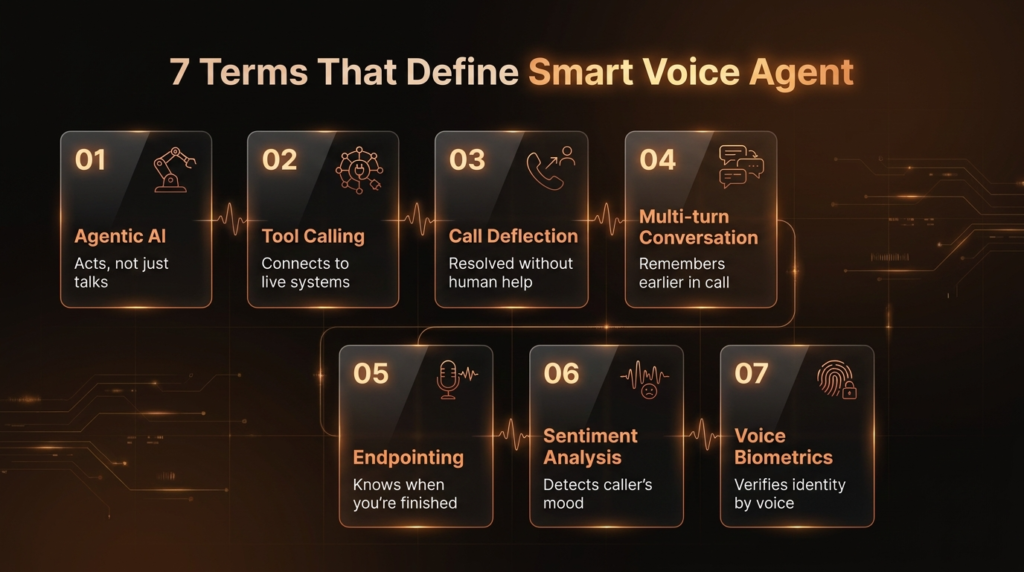
- Agentic AI: A voice or chat agent that doesn’t just speak; it actually acts: schedules an appointment, updates a CRM record, or invokes live APIs mid-conversation, etc.
- Tool Calling: How an agent calls an external system or function in a conversation.
- Call Deflection: Percentage of incoming calls that were completely resolved by the AI without human intervention. Deflection rates over 45% are common in many enterprise deployments.
- Multi-turn Conversation: A conversation that can span multiple exchanges, and the AI remembers parts of the conversation from previous exchanges.
- Call escalation / Warm Transfer: When the AI transfers the call to a customer service agent, preferably with a summary so the customer doesn’t have to repeat themselves.
- Endpointing: The ability of the system to recognise when a caller has finished talking, not just stopped talking in the middle of a thought.
- Barge-in: Allow a caller to interrupt the AI during its turn, as happens in a conversation.
- Sentiment Analysis: The AI’s ability to interpret a caller’s tone or emotions during the call, which can be used to indicate, for example, when the caller is getting frustrated and thereby escalate to a human agent.
- Voice Biometrics: This essentially aims to identify an individual by calling on their voice, a growing trend in place of or in addition to using a PIN or security question.
Several AI voice agent terms come up in ROI conversations and understanding them can help teams to counter misleading sales pitches or estimates.
How Does a Conversational AI Glossary Differ From a Voice AI Glossary?
Many buyers make the mistake of not making this distinction. A conversational AI glossary is a set of terms for the overall term, which includes chatbots, virtual assistants, and any AI with a multi-turn conversation across channels. A voice AI glossary is more restrictive: it applies to voice interactions, such as on the phone or via a voice interface.
While technically a part of conversational AI, voice AI adds a whole new lexicon, including latency, endpointing, barge-in, DTMF, etc., that’s not on the conversational AI glossary list. When a vendor starts using them interchangeably, it’s usually an indicator that they are newer to the voice specific side of the business, and they have to deal with things that text-based bots simply don’t encounter, such as audio timing, telephony infrastructure, and real-time streaming.
Why Voice AI Terminology Matters When Choosing a Vendor
Sometimes, even the same words are not interpreted the same way by voice AI vendors. Some providers have a latency of 300ms where others have a latency of 1.2 seconds. If there is no common voice AI glossary, procurement teams can end up in contracts that are based on assumptions and not specifications.
There are a couple of practical reasons this common jargon is important at the table:
- Benchmarking is Made Easier: you can now easily compare vendors apples to apples, not on marketing claims, after understanding WER, latency, and deflection rate.
- Budget Discussions Get Better: you use the savings obtained from knowing the difference between ASR licensing, LLM inference costs, and telephony fees.
- Risks are Brought to the Surface Sooner: Data retention, on-device processing, and voice cloning consent are terms that have compliance consequences that need to be surfaced before signing.
- It Speeds up Internal Buy-in: when IT, ops, and customer experience teams speak the same voice AI terminology decisions are made quicker.
How Is Voice AI Glossary Terminology Evolving in 2026?
Voice AI terminology is not static. Over the years, a few changes to watch for:
- Agentic AI is now commonplace. Voice agents are no longer just expected to answer queries; they are expected to act, so any current voice AI glossary should include tool calling and MCP-based integrations.
- Voice AI is becoming on-device and private-cloud as data residency and compliance needs dictate the architecture in healthcare and financial services.
- Synthetic voice cloning for brand differentiation has become commonplace but is adding new language to consent and disclosure.
- One reason that a conversational AI glossary and voice AI glossary are becoming similar at their edges is because of omnichannel consolidation, where the line between voice and chat platforms is blurring.
It’s no longer a luxury; it’s a necessary part of being up to speed on this vocabulary for every investment in AI. Documentation that is updated regularly and is split into core voice AI terminology and proprietary feature names is generally easier to work with in the long run; it’s a small signal but a helpful one.
How Should Teams Actually Use a Voice AI Glossary Day-to-Day?
If it’s not used, then it’s not a glossary. Some good habits to adopt:
- Share it in advance with vendor calls. If people are attending a demo, share the part of your voice AI glossary with them to keep questions fresh and consistent.
- Stick it in the RFP templates. Having procurement documents stating ASR, latency, and deflection rate ahead of time makes it much easier to compare vendor responses side by side.
- Revisit it quarterly. Voice AI terminology is constantly evolving, so what you read a year ago may not be relevant to the present, with some terms such as voice biometrics and MCP being totally different.
- Utilize it to teach new employees. Anyone who joins a sales or support team or an IT team that touches voice AI will receive a 15-minute tour of key terms in advance of their first vendor meeting.
If treated like this, a voice AI glossary is no longer a reference and becomes a light-touch onboarding and alignment tool.
Conclusion
Voice AI is no longer a futuristic technology; it’s now an essential part of customer engagement, and the lexicon is growing at a similar rate. From vendor comparisons to briefing your leadership team to just keeping up, a trustworthy voice AI glossary makes confusing jargon decision-ready knowledge. All of these, including ASR, latency, agentic AI, and call deflection, are not just here to stay; they are the modern language of voice technology. Bookmark this glossary, distribute it to your team, and refer to it as new terms are discovered. The first step to making better, faster choices with the voice AI that you build or buy is understanding the language.
Frequently Asked Questions
What is a voice AI glossary used for?
Defines voice AI terminology such as ASR, TTS, latency, agentic AI, and more, so businesses can confidently evaluate vendors and read through voice AI proposals without requiring a technical or engineering background.
What’s the difference between ASR and NLP in voice AI?
ASR is a tool that translates spoken words into text. NLP then “reads” that text to try to decipher intent and meaning. ASR is responsible for the “hearing,” while NLP is responsible for the “understanding” of what is said.
Are voice AI and conversational AI the same thing?
No. Chat and voice are both included in the category of conversational AI. Voice AI is a more specific model of AI that works just with voice communications from calls or voice interfaces.
How often does voice AI terminology change?
Frequently. As new AI voice agent features come to fruition, such as agentic actions, tool calling, and voice cloning, glossaries must be updated regularly to be useful.