
What is time to first token? It is the time, measured from a user’s prompt to the first word of the output generated by a large language model. Measures the time elapsed between a user’s prompt and the first word of the output generated by a large language model. TTFT – milliseconds until the AI system provides an answer, not the answer itself. It includes queueing, prompt processing, generation of a first token, and overhead for the network. Low TTFT gives chatbots an instant feeling and keeps the latency of voice AI low enough for natural talk, while high TTFT results in dead air, even if the answer is correct. This guide explains the metric, how it relates to total latency, and what really drives it down.
What Is Time to First Token in an LLM?
Ask any chatbot a question, and there’s a short silence before the answer starts. That silence is the heart of every time to first token LLM conversation. So what is time to first token in practice? It’s the wait between hitting send and seeing the first chunk of text come back.
What Is Time to First Token: A Plain Definition
A token is a small piece of text, typically an entire word or a portion of a word. The TTFT is the timer that begins at the time the request leaves the user and ends at the time the first token is ready to be displayed. If someone asks, what is time to first token, the answer is: one clock, one moment.
Time to First Token LLM Metrics in Context
TTFT indicates the speed at which an individual obtains any response from the system that they hear. If not, then what is the number that makes a first impression? Time to first token! So, if it’s not the number that makes a first impression, then what is it? Time to first token! These two models can produce the same answers, but the model that begins in 300 milliseconds is more of a “sharper” model than the one that begins after three seconds.
Why Does Time to First Token Matter for User Experience?
People rarely wait for a finished answer. They wait for something to begin. Once text appears, patience stretches. That is why teams keep asking what is time to first token in their own product, and whether it’s good enough.
The Human Benchmark for Response Gaps
Human conversation sets the bar. The average gap between conversational turns was about 208 milliseconds. We grow up expecting near-instant replies, so a slow start reads as hesitation, even when it comes from software. What is time to first token, if not the AI version of that pause before someone answers?
What Is Time to First Token Worth to the Business
The commercial side is real too:
- High TTFT: users retry requests, lose trust, and sometimes abandon the tool entirely.
- Low TTFT: the product feels responsive, conversations flow, and adoption tends to follow.
In TTFT voice AI products, the effect is sharper still, because silence on a call feels like a failure.
How Does Time to First Token Work Behind the Scenes?
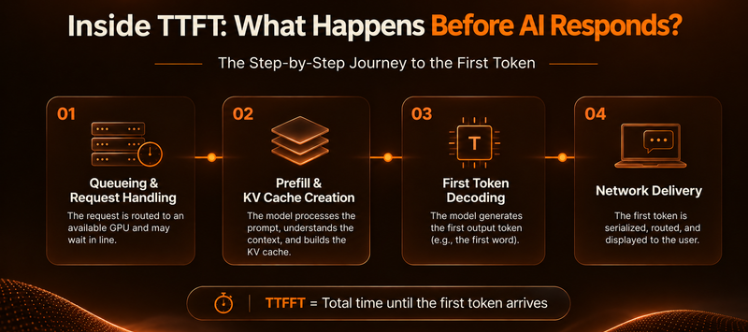
Before a model says a single word, several steps happen in sequence. TTFT is the sum of all of them, and knowing what is time to first token made of tells you where to look when it gets slow.
Queueing and Request Handling
The request is routed to an available GPU. Under heavy traffic, it waits in line, and that wait counts toward TTFT.
Prefill and KV Cache Creation
Next, the model reads the entire prompt, works out how every part relates to the rest, and builds the KV cache it will reuse later. This is usually the biggest slice of TTFT, especially with long prompts. Ask what is time to first token dominated by, and prefill is usually the answer.
First Token Decoding and Network Overhead
Finally, the model produces its first output token, and serialization, routing, and buffering carry it to the screen. So what is time to first token made of? Four stages and one clock, and weakness in any single stage drags the whole number up.
How Do TTFT vs Total Latency Differ?
Total latency is the whole trip, from request to the final token. TTFT is only the first leg. Understanding TTFT vs total latency helps you pick the right target for each product.
The Formula Linking TTFT and Total Latency
Total latency ≈ TTFT + (output tokens – 1) × inter-token latency
Tokens per second and inter-token latency describe the second half of that equation. What is time to first token compared with them? It’s the first half, and the only part users feel before anything else happens.
A Worked Example With Two Systems
Say a reply is 150 tokens long. System A has a TTFT of 300 ms and produces a token every 30 ms, so it finishes in about 4.8 seconds. System B has a TTFT of 900 ms but produces a token every 15 ms, so it finishes in about 3.1 seconds. B finishes first, yet A feels faster to start. That gap is TTFT vs total latency in action, and it shows what is time to first token really doing: setting the first impression, not the finish line. Both numbers shape LLM response latency, just in different ways.
When to Prioritize Each Metric
A streaming chat window usually favors A, because the reader is busy reading while the rest arrives. A background summarization job favors B, because nobody is watching it begin. That’s the heart of TTFT vs total latency: they answer different questions, so neither should be tracked alone.
How Does a Streaming LLM Response Change What Users Feel?
A streaming LLM response sends tokens to the user as they’re generated instead of holding everything until the answer is complete. The model doesn’t get any faster. The experience does. Here, what is time to first token really measuring? The moment the first streamed chunk lands. It doesn’t cut LLM response latency overall; it hides it.
Why Streaming Shrinks the Perceived Wait
Without streaming, the user’s wait equals total latency. With a streaming LLM response, the wait shrinks to TTFT, and the rest of the generation happens while they read. So what is time to first token worth once streaming is on? Nearly everything, because it’s now the wait people actually feel.
Where Buffering Breaks Streaming
One catch is worth flagging. A streaming LLM response only helps if tokens actually reach the screen. A proxy, gateway, or front-end component that buffers output can hold back a first token that was generated on time.
Why Does TTFT Voice AI Behave Differently From Chat?
Chat has a cushion, like a spinner or typing dots. Voice has none of that. When a caller stops speaking, there’s just silence, and silence reads as a dropped line or a confused agent. That’s why TTFT voice AI needs its own playbook.
The Voice Pipeline Behind Voice AI Latency
Voice AI latency is usually defined as the time from when the caller stops talking to when the agent starts talking. A typical pipeline looks like this:
- Detecting that the caller has finished their turn
- Finalizing the speech-to-text transcript
- Waiting for the LLM’s first token
- Converting that first piece of text into audio
- Sending the audio back over the network
What Is Time to First Token Worth in a Voice Agent
So what is time to first token in a voice agent? The middle step of five. Even strong TTFT voice AI numbers can sound slow if turn detection lags or text-to-speech takes its time. Think of LLM response latency as a budget, and the model only gets a slice of it. Commonly cited figures put model TTFT near 300 to 500 ms in streaming pipelines.
Practical Voice AI Latency Targets
The natural time window for humans is around 200-300 milliseconds. A lot of teams consider 800ms end-to-end to be good for a task-focused call, and 500ms or less to be great for the best experiences. Don’t use them as the law of the land – because of the different voice AI latency requirements in a banking assistant versus a casual companion app. Within those targets, what is time to first token allowed to spend? That depends on how much the other stages already cost.
Ways to Hide Latency You Cannot Remove
- Stream sentence by sentence: Send the first full sentence to the LLM whose responses stream while the LLM continues to write.
- Use short acknowledgments: a quick “let me check that” fills the gap better than silence.
- Keep voice prompts lean: long system prompts raise prefill time on every turn.
What Factors Increase LLM Response Latency?
LLM response latency isn’t always caused by one factor. When you know what is time to first token is sensitive to, then you can rank fixes by impact, rather than by guesswork.
Prompt Length and Model Size
So the more input tokens, the more prefill tokens there will be before the first token appears, and the larger the model is, the more computation will be required at each step. The time to first token in LLM tuning typically increases with each additional paragraph in a system prompt, as it incurs an additional cost for every request.
Batching, Concurrency, and GPU Load
A grouping request increases throughput, but a large batch request will cause an individual request to wait longer. There are queues formed by many requests made at once, and poor scheduling or inadequate hardware adds delay before work begins. These effects are inescapable if you’re telling the truth about what is time to first token under load.
Network and API Layers
Distance, serialization, and buffering all add milliseconds. These costs hurt TTFT voice AI deployments most, since every extra network hop lands inside the caller’s silence.
How Can You Reduce Time to First Token?
There’s no single switch. Teams that get good results work across the whole inference pipeline. Whatever the answer to what is time to first token in your stack today, start with the cheapest change first.
Prompt and Caching Fixes
Cut repeated instructions and retrieve fewer, tighter chunks in RAG setups. Then use KV cache and prefix caching so the model stops re-reading the same system prompt. The prompt is almost always the cheapest win.
Model and Serving Fixes
Smaller, distilled, or quantized models are suitable for turns with low latency requirements. Separating prefill and decode allows leverage compute efficiently; also, use smaller batches for interactive traffic.
Infrastructure and Network Fixes
Autoscale GPUs in advance of peak hours to prevent queueing delay, maintain warm connections, and use endpoints close to users. These changes require more effort, but they are beneficial for any voice AI latency requirement. After all of them, what is time to first token in your stack? Noticeably lower.
How Do You Measure Time to First Token the Right Way?
It is a rare average that tells the truth. Honestly, the first time that someone asks you what is “time to first token” for your product, the answer is a distribution, not one number.
Client-Side Measurement
Use measurements from the client (including buffering & network time). Ask the user, before tuning, what the first token is in their mind. A server-side TTFT may appear healthy, but the user will still be waiting, and the client time is even more important for TTFT voice AI.
Percentiles and Segmentation
Monitor percentiles rather than averages, as a good average may be accompanied by a very poor percentile. The time to first token at p95 can reveal the pain of real users and should be a part of a time to first token LLM dashboard. Use cached prompts for warm requests and cold prompts for long requests, and/or limit the number of prompts in a segment.
Metrics to Pair With TTFT
Pair TTFT with inter-token latency, tokens per second, and total latency, so TTFT vs total latency is always visible side by side. For voice, measure voice to voice, from the end of the caller’s speech to the first audible sound. That is the number that reflects real LLM response latency as the caller hears it.
What Is Time to First Token Really About? A Final Word
So what is time to first token in one line? It’s the moment an AI system goes from silent to responsive, and users judge a product by that moment before they judge anything else. Keep TTFT vs. total latency separate, track the tail instead of the average, and remember that in TTFT voice AI, the model only owns a slice of the voice AI latency budget. Trim prompts, cache what repeats, deliver every answer as a streaming LLM response, and measure from the user’s side. Treat time to first token LLM tuning as ongoing work. Do that consistently and your assistant stops feeling like software that’s thinking and starts feeling like something that’s listening.
What Do People Ask Most About Time to First Token?
What is time to first token in simple words?
Time to first token is the wait between sending a prompt and seeing the first output chunk. It shows how fast a model starts responding, not when it finishes generating.
What is a good time to first token LLM target?
There’s no universal number, but lower is better. Many teams aim for a few hundred milliseconds in chat and less in voice, depending on prompt length, model size, and workload.
Is TTFT the same as total latency?
No. TTFT measures only the wait for the first token. Total latency covers the entire response, from request to the final token, including the time spent generating every remaining token.
Does a streaming LLM response reduce time to first token?
Not directly. Streaming delivers tokens as they’re generated, so users see output sooner, and the wait feels shorter, but TTFT itself only improves when the underlying system actually gets faster.