
A large language model (LLM) is an AI system that is trained on a vast amount of text to understand context and produce human-like text. It works by predicting the next word in a sequence and uses billions of parameters in a transformer architecture. It’s used in voice AI systems between speech recognition and speech synthesis, determining the next word in a phrase. In this guide, we will address the question, “How do large language models work? It also explores the differences between LLMs and traditional AI, the models most appropriate for conversational AI, the potential for latency, and the risk of hallucination, as well as the value of fine-tuning LLMs for voice assistants. Consider it a user-friendly introduction to the use of voice technology for every audio builder and purchaser.
What Is a Large Language Model, and Why Is Everyone Talking About It?
The Simple Definition
A few words about a large language model: Removing the noise, you have a very well-read pattern spotter. It has been trained to recognize what words follow other words in books, articles, code, and web pages. This is sufficient for answering questions, summarizing documents, translating languages, and holding a conversation.
Why the Market Is Paying Attention
The funds are going where the ability is. The market for AI platforms and models is expected to reach $64 billion this year, and spending on generative AI models will continue to increase by 117% in 2026, according to Gartner.
With voice technology, it’s all about that momentum. Behind the scenes, a large language model is responsible for a lot of the phones, smart speakers, and in-car assistants that are not as robotic as they were a few years ago.
How Do Large Language Models Work?
Tokenization and embedding
Text is broken down into small segments referred to as tokens, which may be word(s) or parts of words or punctuation. The model doesn’t receive raw sentences, but rather runs a sequence of tokens that have been converted into numbers. Each token is then a vector, a list of numbers, that represents meaning. In this mathematical space, words that are used in similar ways are placed near each other.
Transformers and Self-Attention
The transformer architecture uses self-attention to weigh how strongly each token relates to every other token in the passage. That is how the model knows “it” means the phone in one sentence and the invoice in another.
Next-Token Prediction and Training
The model scores every possible next token, picks one, adds it to the sequence and repeats. Loop after loop, that produces fluent text. Training happens in stages: pre-training builds general language ability, fine-tuning narrows the model toward a task, and reinforcement learning from human feedback nudges answers toward what people find useful and safe.
So, how do large language models work in practice? Once you see how these steps fit together, most large language model behavior, good and bad, starts to make sense.
What Is Natural Language Understanding, and Where Does It Fit In?
From Hand-Built Rules to Learned Understanding
Natural language understanding (NLU) is the capability of a system to derive meaning from a user’s natural language, rather than his or her literal words. The older tools for NLU were based on manually defined rules and intent classifiers. If anyone called in and said that “I need to move my appointment,” it had to follow a pattern that had been rewritten.
A large language model is trained with incidental learning of natural language understanding today. Consumes intent, sentiment, entities, and even sarcasm from context. This is why a modern assistant can pick up on “Actually, make that Thursday, and can I bring my daughter?” without getting stumped.
Where Natural Language Understanding Still Struggles
Even when accents are heavy, background noise, when a sentence switches languages, and niche jargon are still a problem. Such gaps are typically at the speech layer or due to a lack of domain data, meaning that much more than just the model is required to enable strong natural language understanding.
LLM vs Traditional AI Models: What Is the Real Difference?
How Traditional AI Models Work
Traditional AI models are created for a single purpose. Classifiers classify intents, rules engine follows decision tree, churn statistical model predicts churn. They are easily predictable, cost-effective, and easily auditable. They, however, require labeled data for each of the tasks, and they fail when users fail to follow the script.
What Changes with an Large Language Model
A large language model flips that trade-off. One model can summarize, translate, reason through a request and write a reply, often with just a prompt and a few examples. In the LLM vs traditional AI models comparison, four differences stand out:
- Flexibility: Traditional models handle narrow tasks. LLMs generalize across many.
- Data needs: Traditional models want task-specific labeled data. An LLM starts with broad pre-training and adapts with little or no additional data.
- Predictability: Rules and classifiers give the same answer every time. LLM outputs can vary between runs.
- Cost and speed: Small traditional models are quick and cheap. A large language model needs far more compute per response.
Using Both Together
The smart move usually isn’t picking one. Many strong voice systems keep fixed logic for payments and identity checks and let the LLM handle the open-ended conversation. That hybrid approach is where LLM vs traditional AI models stops being a rivalry and becomes a design choice.
How Are LLMs in Voice AI Applications Used Today?
The Voice AI Pipeline
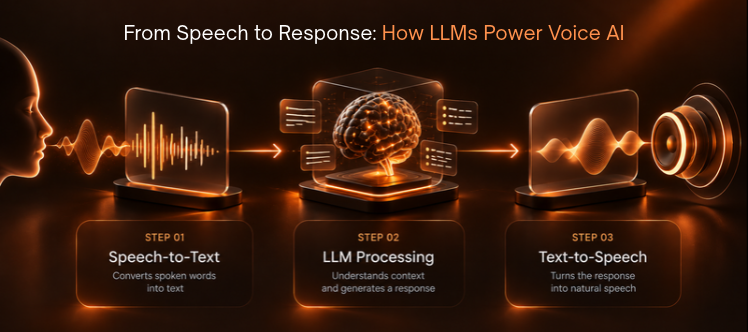
LLMs in voice AI applications rarely work alone. A typical pipeline has three stages: speech-to-text turns audio into words, the LLM decides what to say, and text-to-speech turns the reply back into audio. Newer speech-native models fold some of these steps together, but the three-stage setup is still the most common in production because each part can be swapped and tested on its own.
Common Use Cases
Behind every one of these, a large language model handles the reasoning and the wording of the reply:
- Customer support lines that resolve routine queries without a human handoff
- Appointment booking and reminders for clinics, salons and service businesses
- Voice assistants inside cars, wearables, and smart homes
- Sales and lead-qualification calls
- Meeting assistants that transcribe, summarize and pull out action items
Why Does Large Language Model Latency for Real-Time Voice Matter So Much?
The Latency Budget
People are impatient listeners. In human conversation, the gap between one speaker finishing and the next starting is a fraction of a second, so a two-second pause on a phone call feels broken. On a call, users don’t wait politely. They say “hello?”
Voice teams usually work with a latency budget. A common rule of thumb is to keep the full voice-to-voice response under about 1.5 seconds. Once speech recognition, speech synthesis and network hops take their share, that leaves roughly 500 to 700 milliseconds of time-to-first-token for the model. LLM latency for real-time voice is often the one part of that budget a team can actually control.
Ways to Reduce LLM Latency for Real-Time Voice
- Stream the output. Start speech synthesis as soon as the first few tokens arrive instead of waiting for the full reply.
- Use a smaller, faster model for routine turns and save heavier models for complex ones.
- Trim the prompt. Long system prompts and bloated conversation history add processing time.
- Cache and prefetch. Load account data or FAQ context before the model needs it.
- Consider speech-native models. Research suggests they can skip the separate transcription step and cut first-token time considerably, though with less flexibility.
Which Are the Best LLMs for Conversational AI?
Popular Model Families
There is no single winner, and anyone who names one without asking about your use case is guessing. Independent 2026 comparisons keep landing on the same conclusion: the best model is the fastest one that passes your own tests for instruction following, tool use and tone. Still, a few of the best LLMs for conversational AI come up again and again in voice deployments:
- OpenAI GPT-4.1 and GPT-4o. Popular defaults for phone agents thanks to dependable function calling and low first-token times.
- Google Gemini Flash models. Quick, affordable and strong on multilingual conversations.
- Anthropic Claude Sonnet models. Known for careful instruction following and steady response times, often picked for regulated workflows.
- Open-weight models such as Llama, on fast inference hardware. A good fit when you want control over data, hosting and cost.
How to Evaluate the Best LLMs for Conversational AI
Score each option on five things: time to first token, tool-calling reliability, context window, multilingual accuracy and cost per minute of conversation. Then test every large language model on real call recordings, not demo prompts. A model that shines on a benchmark can still stumble on your customers’ accents and your product names.
What Causes LLM Hallucination and Accuracy Issues?
Why Hallucinations Happen
A hallucination is a confident answer that happens to be wrong, and every large language model produces some. The model is built to produce plausible text, not to verify facts, so when training data is thin or a question is ambiguous, it fills the gap with something that sounds right.
On a live call, that’s risky. The listener can’t scroll back or check a source, and a voice assistant that invents a refund rule or misquotes a dosage does real damage. Common causes of LLM hallucination and accuracy issues include:
- Gaps or outdated information in the training data
- Vague prompts or missing context
- Speech recognition errors that feed the model the wrong words
Ways to Reduce LLM Hallucination and Accuracy Issues
- Ground answers with retrieval. Retrieval-augmented generation lets the model pull from your approved knowledge base before it replies.
- Limit the scope. Tell the assistant what it should not answer, and give it a clean way to hand off to a human.
- Use structured tool calls for facts like prices, availability and account status.
- Monitor real conversations. Review transcripts, flag failures and feed them back into prompts and training data.
No technique removes hallucination entirely, so a large language model in production should always come with guardrails and a human fallback.
Is Fine-Tuning LLMs for Voice Assistants Worth It?
What Fine-Tuning LLMs for Voice Assistants Can Improve
Fine-tuning means continuing a model’s training on your own examples so it picks up your vocabulary, tone and workflows. For fine-tuning LLMs for voice assistants, the most common wins are:
- Shorter, more natural spoken replies instead of essay-style answers
- Correct handling of product names, medical terms or industry jargon
- A consistent brand voice across thousands of calls
- Reliable formatting for tool calls
When to Skip It and What to Try First
Try the cheaper options first. Good prompting, few-shot examples and retrieval solve a surprising share of problems with no training at all. Fine-tuning LLMs for voice assistants earns its cost when you have a large set of clean, representative conversations, a stable use case and a clear metric to improve, such as containment rate.
Two cautions apply. Training on messy transcripts teaches the model messy habits, and private call data requires consent, redaction and solid security. On the plus side, a smaller fine-tuned model can beat a bigger general one on a narrow task, and it usually answers faster.
What Does the Future of Large Language Models in Voice Look Like?
Faster Speech-Native Models
Models that handle audio directly will keep cutting LLM latency for real-time voice and widening what LLMs in voice AI applications can do.
Smaller, Specialized Models
Domain-specific models will take over routine work and can ease LLM hallucination and accuracy issues, while a heavier large language model is saved for hard problems.
Agentic Voice Assistants
Assistants will move from answering questions to completing tasks, like rebooking a flight or updating a record, across connected systems.
What Is the Takeaway on Large Language Models for Voice AI?
Voice technology has evolved from a fixed menu to one that can listen, thanks to the introduction of large language models (LLMs). They understand what you are saying, they have context, and they respond in natural language, but they are not magic. It is not a leader board; it depends on the use case, and it is the speed that determines whether the conversation feels human, and grounding is a determining factor for whether it can be trusted. Groups that take real tests, establish strict boundaries, and adjust when it is advantageous are the ones that fare best. As models become faster and more niche, the voice AI winners will be the ones that design well and consistently measure.
What Do People Ask Most About LLMs?
What is a large language model in simple terms?
Large Language Model (LLM) is an AI system that is trained using large amounts of text data to recognize and produce human language. It predicts words in context and is used for chatbots, translation, and voice assistants.
How does a large language model differ from traditional AI?
The traditional models of AI perform one task with rules or labeled data. A single model, trained on text, can answer, summarize, translate, and reason on many tasks.
Why do large language models hallucinate?
LLMs hallucinate because they just output the most likely sounding text that doesn’t necessarily reflect actual facts. When there is insufficient training data, imprecise prompts, and missing context, the answers are often confidently wrong.
Which large language model is best for voice assistants?
There is no one right answer. Select a model that has low time to first token, good tool-calling capabilities, and high accuracy for your application, and run it on real conversations before deployment.